Integrating Live Data Streams with Dynamic Stake Adjustments for Combat Sports Round Markets
Rosa Weber · Aug 27, 2026
Integrating Live Data Streams with Dynamic Stake Adjustments for Combat Sports Round Markets
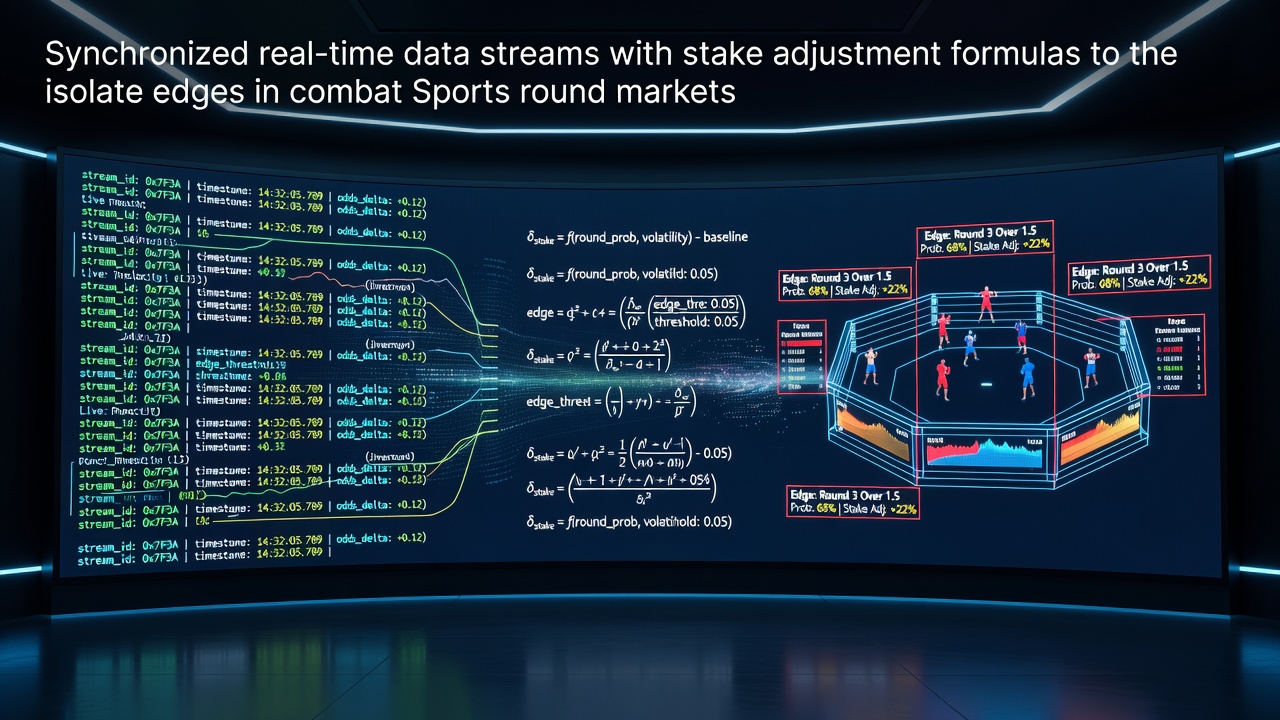
Combat sports round markets present unique challenges because fight dynamics shift rapidly within each three or five minute segment and data from multiple sources must align precisely to identify pricing discrepancies. Platforms aggregate inputs from official scoring systems, sensor feeds on fighter movement, and live odds across exchanges while stake adjustment formulas recalibrate exposure based on incoming signals.
Core Components of Data Synchronization
Real-time streams include punch accuracy metrics, takedown success rates, and heart rate variability captured through wearable devices during events. These feeds merge with historical fight databases through timestamped protocols that eliminate latency gaps, allowing formulas to process updates within milliseconds. Observers note that misalignment between streams often erases small edges, which is why synchronization layers use redundant validation checks before passing information to staking engines.
Stake adjustment formulas typically incorporate elements of the Kelly criterion modified for live variance, where updated probabilities from the data streams trigger proportional increases or decreases in position size. For instance, a sudden drop in a fighter's output during round two can shift implied probabilities on the over/under for total strikes, prompting the formula to resize the wager while maintaining overall bankroll thresholds.
Application in MMA and Boxing Round Markets
In August 2026 several major promotions expanded round-specific prop offerings, with data providers supplying granular metrics on strike velocity and clinch duration. Those who studied these markets found that synchronized feeds revealed overlays when public odds lagged behind sensor-derived fatigue indicators. Formulas then adjusted stakes dynamically, scaling down after high-variance rounds and scaling up when patterns stabilized.
Boxing events add another layer because judges' scorecards update publicly between rounds, creating discrete synchronization points. Aggregators combine these updates with real-time punch statistics to recalibrate round winner probabilities, and stake tools apply the revised figures without manual intervention.
Technical Implementation Challenges
Latency remains a primary concern because even sub-second delays can distort edge calculations in fast-paced exchanges. Engineers deploy edge computing nodes near exchange servers to compress and validate streams before transmission to central models. Data indicates that organizations using distributed architectures reduced synchronization errors by measurable margins compared with centralized setups.

Security protocols also matter because unauthorized access to proprietary feeds could undermine the entire process. Industry reports from the Australian Gambling Research Centre highlight encryption standards adopted across multiple jurisdictions to protect live data integrity.
Formula Variations Across Different Combat Disciplines
MMA round markets often emphasize grappling metrics and submission attempts, whereas boxing focuses more on punch volume and ring generalship scores. Formulas adapt by weighting incoming variables differently, with MMA versions incorporating ground control time as a heavier factor. Researchers discovered that discipline-specific tuning improved predictive accuracy when tested against archived fight data from 2024 through mid-2026.
Multi-round fights introduce compounding effects because early-round outcomes influence later probabilities. Stake adjustment mechanisms account for this by applying decay functions that reduce exposure as the fight progresses unless new data strongly contradicts prior assumptions.
Regulatory Context and Industry Standards
Agencies such as the Pennsylvania Gaming Control Board have issued guidelines on algorithmic betting tools that require transparency in how formulas recalibrate stakes. Compliance involves logging every data input and output adjustment for audit purposes, which adds processing overhead yet maintains market integrity.
Those who've examined cross-border operations note that European and North American frameworks differ in their treatment of live prop markets, prompting some platforms to maintain separate synchronization pipelines for each region.
Conclusion
Synchronizing real-time streams with stake formulas creates a structured approach to isolating edges in combat sports round markets. The combination of low-latency data integration and dynamic position sizing allows systematic responses to evolving fight conditions without relying on manual intervention. Continued refinement of these systems depends on advances in sensor technology and validation protocols that keep pace with expanding prop offerings.