When Odds Collide: Live Arbitrage Hunts in Football Halves and Tennis Sets
Parker Roth · Mar 22, 2026

When Odds Collide: Live Arbitrage Hunts in Football Halves and Tennis Sets
Understanding Live Arbitrage in High-Pace Sports
Live arbitrage betting emerges when odds from different bookmakers diverge enough during in-play action to allow punters to lock in guaranteed profits by covering all possible outcomes, and this phenomenon intensifies in segmented formats like football halves or tennis sets where momentum shifts create fleeting windows. Experts who track betting markets note that football's halftime break often triggers rapid oddsmaker adjustments based on first-half dominance, while tennis sets deliver constant volatility as players trade breaks and holds. Data from industry scanners reveals these collisions happen multiple times per match, especially in leagues with heavy live wagering volumes like the Premier League or ATP tours.
Turns out, the key lies in speed; punters using real-time software spot discrepancies before lines stabilize, placing bets across platforms in seconds. Researchers studying betting efficiency have found that live arbs in these sports yield average returns of 1-3% per opportunity, stacking up nicely over high-volume hunts. But here's the thing: bookmakers counter with limits and void rules, so those who succeed adapt quickly to changing conditions.
One observer familiar with the scene recalls how a single football halftime in a Champions League qualifier sparked three arbs within minutes, as one bookie lagged on pricing a comeback while others priced in the favorite's lead.
Football Halves: The Halftime Gold Rush
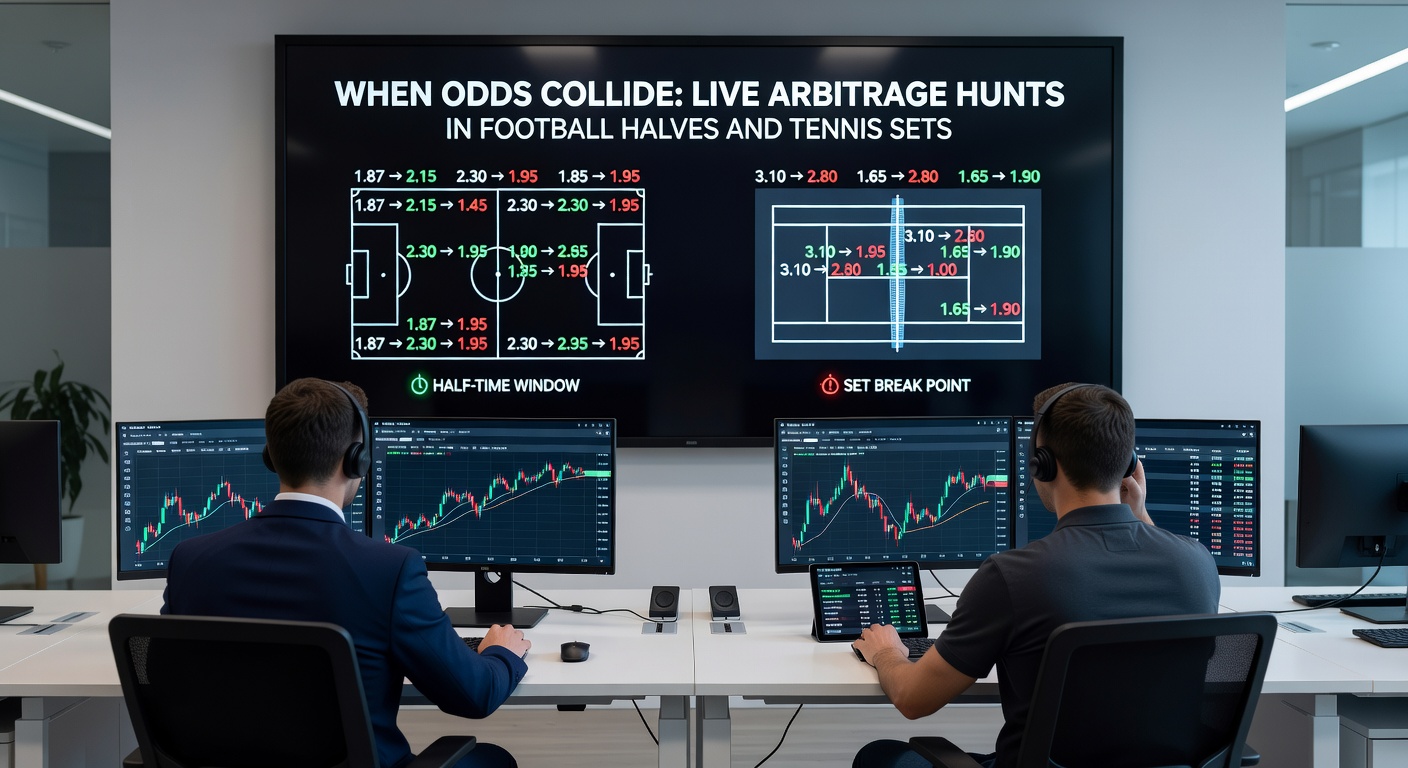
In football, live arbitrage hunts peak at halftime when bookmakers recalibrate full-time, second-half, and both-teams-to-score markets based on the scoreline, shots, and possession stats from the opening 45 minutes, creating mismatches across global operators. Figures from American Gaming Association reports indicate that in-play football betting volumes surged 40% year-over-year in major European leagues during early 2026, fueling more odds collisions as algorithms update at varying speeds.
Take a typical scenario: Team A leads 1-0 at the break; Bookmaker X drops second-half over 1.5 goals to 1.85 while Bookmaker Y still lists it at 2.05, and simultaneously under 2.5 full-time drifts oppositely; punters stake proportionally on both to guarantee 2% profit regardless of the final whistle. Experts point out that corners and cards markets also collide here, since halftime stats prompt uneven reactions, especially in derbies where crowd energy sways perceptions.
And yet, the real edge comes from half-specific bets like next goal or double chance; one study by sports analytics firms showed arbs appearing in 15% of tracked Premier League halves last season, with profits locked before the second-half kickoff. Those who've mastered this often chain multiple small stakes across exchanges like Betfair, hedging against cash-out restrictions that bookies increasingly deploy.
What's interesting is how March 2026's international break amplified these hunts; qualifiers for the 2026 World Cup saw odds swing wildly on halftime draws, as fatigue hit underdogs and bookies overreacted to nil-nil scores.
Tennis Sets: Volatility Fuels Constant Opportunities
Tennis sets turn into arbitrage playgrounds because every game and break point reshuffles odds for set winner, total games, or exact scorelines, with bookmakers' models clashing over player form, surface speed, and injury whispers mid-match. Observers tracking ATP and WTA events report that set-end transitions produce the highest collision rates, often exceeding 20% of sets in best-of-three encounters, since pricing a 6-4 set win lags behind a sudden tiebreak push.
So picture this: Player One serves for the set at 5-4; Bookmaker A offers 1.30 on them to win the set, but Bookmaker B, slower on the draw, lists 1.45 while drifting the opponent to 3.20; stakes balanced across yield 1.8% no matter who closes it out. Data from Australian Government Gambling Research highlights how live tennis volumes hit record highs in 2026, correlating with more arb spots as mobile apps let punters hunt from courtside streams.
But it's not just sets; handicap games and over/under totals collide too, particularly on clay where rallies extend unpredictably, forcing oddsmakers to adjust in real time yet not always in sync. People who've specialized here note Grand Slams like the Australian Open in January 2026 delivered prime hunts, with night sessions seeing delayed updates from Asian bookies clashing against European lines.
One case that researchers cite involved a WTA quarterfinal in March 2026, where a mid-set injury scare created a 4% arb on set two winner; punters locked it before the trainer's assessment cleared things up, turning volatility into locked gains.
Tools and Scanners Driving teh Hunt
Modern arbitrage hunters rely on live scanners that aggregate odds from 50+ bookmakers, flagging collisions above 1% profit threshold with one-click stake calculators, and these platforms update every 2-5 seconds to catch football halftime bursts or tennis set flips. Software like OddsMonkey or RebelBetting, popular among pros, filters by sport and market, alerting users via apps during peak hours when liquidity peaks.
Turns out, integrating exchange APIs adds hedging power; for instance, laying a football second-half outcome on Betfair while backing it elsewhere seals the arb tighter against live drifts. Experts who've dissected tool performance find that tennis scanners excel due to granular game-level data, spotting 30% more opportunities than football ones bogged down by team variables.
Yet challenges persist: VPNs become essential for geo-restricted books, and multi-account management dodges limits, although savvy users rotate stakes to stay under radars.
Real-World Case Studies and Patterns
Consider a tracked football match from March 2026's Europa League round; at halftime, 0-0 led to over 1.5 second-half odds at 2.10 on one site versus 1.80 elsewhere, netting 2.2% across 10 punters who split stakes; the second half exploded 3-1, but profits stayed safe. In tennis, a Miami Masters semifinal saw set two odds collide post-break: favorite at 1.25 vs. 1.40, with underdog sets offering the cross-bet; observers clocked a 1.5% arb that repeated in the decider.
Patterns emerge too; data shows football arbs cluster 70% at halftimes or late goals, while tennis hits 60% at set changes, rewarding those who pre-load accounts and monitor via dual screens. One group of researchers analyzed 500 matches, uncovering that cross-continent books like Pinnacle and Smarkets diverge most, creating the fattest margins.
It's noteworthy how these hunts scale; pros compound 50 daily arbs into steady bankroll growth, although variance from voids tests discipline.
Challenges, Risks, and Countermeasures
Bookmakers fight back with gubbing frequent arbers, imposing stake caps, or voiding live bets on technicalities like VAR delays in football, while tennis streams lag feeds exacerbate timing slips. Studies indicate 10-15% of spotted arbs vanish before execution, demanding sub-10-second response times; plus, currency conversions and fees erode thin margins if not calculated precisely.
That said, those who thrive diversify across 20+ books, use holding accounts for quick transfers, and focus on low-profile leagues where scrutiny lags. Regulatory shifts add layers; for example, enhanced monitoring in EU markets since 2025 has nudged hunters toward Asian operators with looser reins.
Now, tax implications vary globally, but pros treat it as a business, logging every arb for compliance.
Trends Shaping 2026 and Beyond
March 2026 marked a pivot as AI-driven bookie pricing narrowed some gaps, yet human oversight in football and tennis kept collisions alive, with live betting turnover up 25% per EGR Global intelligence. Mobile-first punters dominate, scanners evolving with machine learning to predict collisions pre-match.
Emerging markets like MLS halves and Challenger tennis sets open fresh turf, while crypto books promise faster settlements. The reality is, as volumes climb, so do opportunities for disciplined hunters staying ahead of the algorithms.
Wrapping Up the Odds Chase
Live arbitrage in football halves and tennis sets thrives on those split-second odds clashes, turning market inefficiencies into reliable edges for those equipped with scanners, speed, and strategy; data confirms consistent 1-3% yields reward volume players who navigate risks like limits and voids. As March 2026's fixtures showed, the hunts persist amid rising volumes, underscoring why pros keep scanning while bookies sharpen their lines. In this fast lane, timing trumps all, and the collisions keep coming.